Local life · Maple Ridge, British Columbia
Published
The Maple Ridge telescope that made a mirror out of spinning mercury
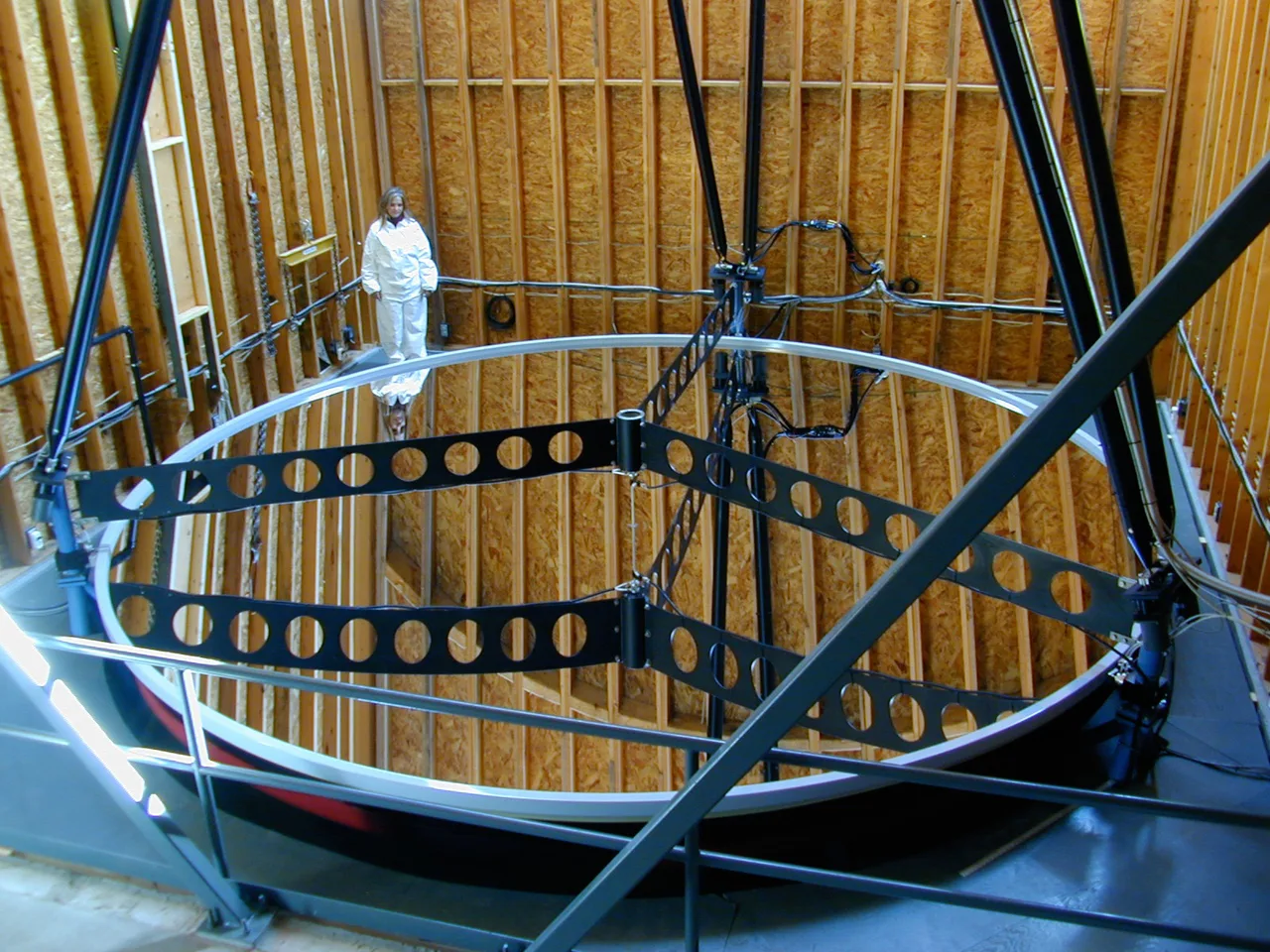
UBC’s six-metre Large Zenith Telescope used spinning liquid mercury to make a curved mirror that focused light. Because the liquid mirror had to remain level, it surveyed the sky passing directly overhead. The Maple Ridge project is now inactive and its building decommissioned.
Facts checked
In this story
A bowl of metal, with astronomical ambitions
Most telescope builders need an exquisitely shaped solid mirror. UBC’s Maple Ridge experiment took a different approach: keep some liquid metal turning and let physics do the shaping. This was an audacious use of a dish. It was not a suggestion for the kitchen.
The six-metre Large Zenith Telescope stood in the Malcolm Knapp Research Forest. UBC’s historical account dates the project to 1994 and completion to spring 2003. Its current notice says the project is inactive and the building fully decommissioned. The fascination now is the instrument, not an observing session to book.
Source: UBC Large Zenith Telescope historical project account
Source: UBC Large Zenith Telescope current decommissioning notice
How the liquid did the difficult bit
The reflecting liquid was mercury. Steady rotation moved it outwards while gravity pulled it down, leaving a surface lower at the centre and higher towards the rim. The resulting shallow bowl is a paraboloid, the shape used to focus light arriving along the telescope’s axis towards a detector above it.
That is the clever economy: the liquid forms the optical curve instead of a solid glass mirror having to be ground and polished into it. It is not simply a large flat puddle reflecting the sky. The dish supports the mercury and the rotating surface supplies the useful reflecting shape.
The catch is just as important. Tilt a solid mirror and it keeps its shape. Tilt a dish of mercury and the liquid redistributes or spills. The mirror’s rotation axis therefore had to stay vertical. The telescope could not turn towards whichever star had caught an astronomer’s fancy. Physics had supplied the mirror and kept control of the itinerary.
Source: UBC Science: liquid-mirror focusing principle and connection to the Large Zenith Telescope
Source: UBC liquid-mirror research group: dish, vertical alignment, air bearing and drive
Source: UBC Large Zenith Telescope historical project account
Let the sky come to you
“Zenith” means directly overhead. Rather than follow a chosen object, the telescope watched a strip of sky pass as Earth turned. A 2001 research description proposed studying distant galaxies and quasars. Think of the difference between following somebody with a camera and watching people pass a fixed window.
The simple idea still required demanding engineering. UBC describes precise levelling, an air bearing, speed control and a cover protecting the surface from wind. A site relatively near the university simplified logistics. Replacing a conventional mirror did not abolish the need for a stable instrument.
A local-forum contributor dismissed the experiment as something that never worked, while others remembered the unusual facility. The published designs and research aims offer a richer account than that verdict. Maple Ridge had an instrument built around a striking exchange: surrender freedom of movement, gain another way to make a very large mirror. It is worth understanding even after the roof has closed.
Source: Large Zenith Telescope Survey research paper, 2001
Source: UBC Large Zenith Telescope historical project account
Source: ASTROLab: UBC liquid-mirror observatory and why its mercury mirror cannot tilt
Source: Maple Ridge niche history discussion, September 2026
Questions people ask
Where was UBC’s Large Zenith Telescope?
It stood in the Malcolm Knapp Research Forest near Maple Ridge.
Source: UBC Large Zenith Telescope historical project account
How large was the liquid mirror?
The mirror measured six metres across.
Source: UBC Large Zenith Telescope historical project account
How did spinning mercury make a telescope mirror?
Steady rotation made the reflective liquid settle into a shallow paraboloid, lower in the middle and higher at the edges. That curve focused incoming light towards a detector above the mirror.
Source: UBC Science: liquid-mirror focusing principle and connection to the Large Zenith Telescope
What does zenith mean in the telescope’s name?
Zenith means the sky directly overhead, the direction the instrument observed.
Source: Large Zenith Telescope Survey research paper, 2001
When did the telescope project begin?
UBC’s historical project account dates its beginning to 1994.
Source: UBC Large Zenith Telescope historical project account
When was the Large Zenith Telescope completed?
The historical project account says it was completed in spring 2003.
Source: UBC Large Zenith Telescope historical project account
What did the telescope aim to study?
The research description proposed a survey of distant galaxies and quasars, among other astronomical targets.
Source: Large Zenith Telescope Survey research paper, 2001
Is the Large Zenith Telescope still operating?
No. UBC says the project is inactive and the building has been fully decommissioned.
Source: UBC Large Zenith Telescope current decommissioning notice
Can I book a visit to use the telescope?
It is not an operating public observatory. The project is inactive and the building decommissioned.
Source: UBC Large Zenith Telescope current decommissioning notice
Why could the Large Zenith Telescope not tilt towards a chosen star?
Its mirror was liquid, so tilting the dish would make the mercury redistribute or spill instead of keeping the required reflecting shape. The dish remained level and the telescope surveyed the sky directly overhead.
Source: ASTROLab: UBC liquid-mirror observatory and why its mercury mirror cannot tilt
Something changed? Tell us about a correction.